
Connecting Research, Community, and Our Natural World
Alex Chavez ’26, Samuel W. Ho Scholar and J.G. Nolan Scholar
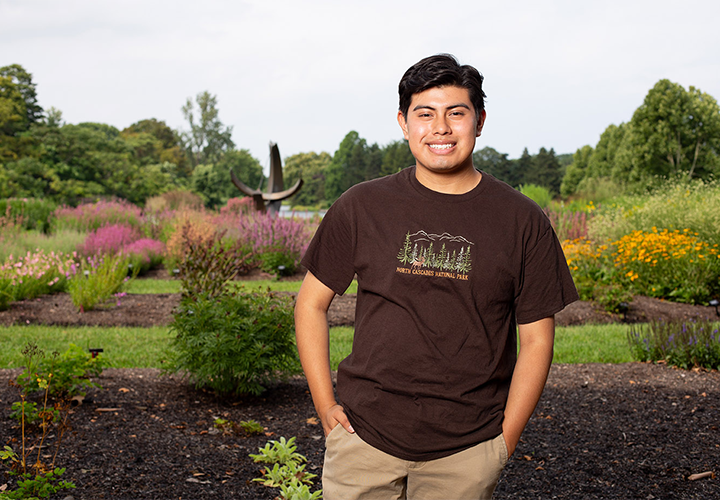
“Growing up in the concrete jungles of Chicago, you don’t see many active green spaces,” says Northwestern University student Alex Chavez ’26. But when Chavez began volunteering with the Forest Preserves of Cook County as a high school student, it made him see his surroundings differently. “I got to meet people who were passionate about preserving what little remains of the areas that resemble the natural landscape,” he says, “and it was very interesting to me.”
The recipient of a Samuel W. Ho Scholarship and J.G. Nolan Scholarship, Chavez chose to major in environmental sciences in the Weinberg College of Arts and Sciences. The summer after his first year at Northwestern, he was awarded a Posner Research Fellowship to partner with a Weinberg College faculty member on an urban ecology project. The work involved encouraging community members in Chicago’s Pilsen neighborhood to create native-garden habitats that would attract monarch butterflies. “I could talk with residents on a personal level about the importance of this, and I really loved it,” says Chavez, who saw how scientific research could have a real-world impact.
Chavez connects his desire to study environmental issues to his personal history. His family has roots in the agrarian, indigenous communities of Central Mexico, where extended droughts in the 1960s caused widespread crop failures, leading to waves of migration. “When I think about that,” he says, “it really makes sense to me that I’ve followed this line of study.”
With funding from Northwestern’s Summer Internship Grant Program (SIGP) and other sources, Chavez has gained valuable experience as a researcher with the Chicago Botanic Garden. For one project, he helped catalog urban bee populations across the Chicago area. Now he is studying the environmental conditions that help native plants thrive on Dolomite prairies in northern Illinois, an especially challenging site for restoration.
In addition to supporting research opportunities, scholarships and other sources of funding allow Northwestern students to focus more on following their passions. In 2024, Chavez studied abroad in Ecuador, where he helped a global reserve assess sites where trees could be planted to restore the ecosystem in a cloud forest. “I would not have had that incredible experience without funding through Northwestern’s Global Learning Office,” he says.
Chavez has also pursued volunteer opportunities that matter to him. He became a “TreeKeeper” with Openlands—a Chicago-based nonprofit—earning a certificate in best practices for protecting and growing urban forests. He is proud to have served as an advising fellow for Matriculate, a program that matches Northwestern mentors with first-generation high school students who demonstrate financial need. “I’m a first-generation student myself,” Chavez says, “so being able to be a mentor is very rewarding.”
Looking ahead, Chavez hopes to take a gap year to do ecological or environmental work before pursuing graduate studies. He would also like to work abroad. “As scientific and environmental careers become more demanding and competitive, experience is becoming more important,” he says. “Having funding gives you the opportunity to take your time and really explore, and gain those experiences that are critical for students’ growth and pre-career development.”
Chavez has a heartfelt message for the University’s financial aid supporters. “Students who receive scholarships would not be able to achieve our dreams without the help and support of donors—and Northwestern’s impact as an institution would be lessened, too. Thank you for investing in us.”